Football Positions Explained: Offense, Defense & Special Teams
July 10, 2026
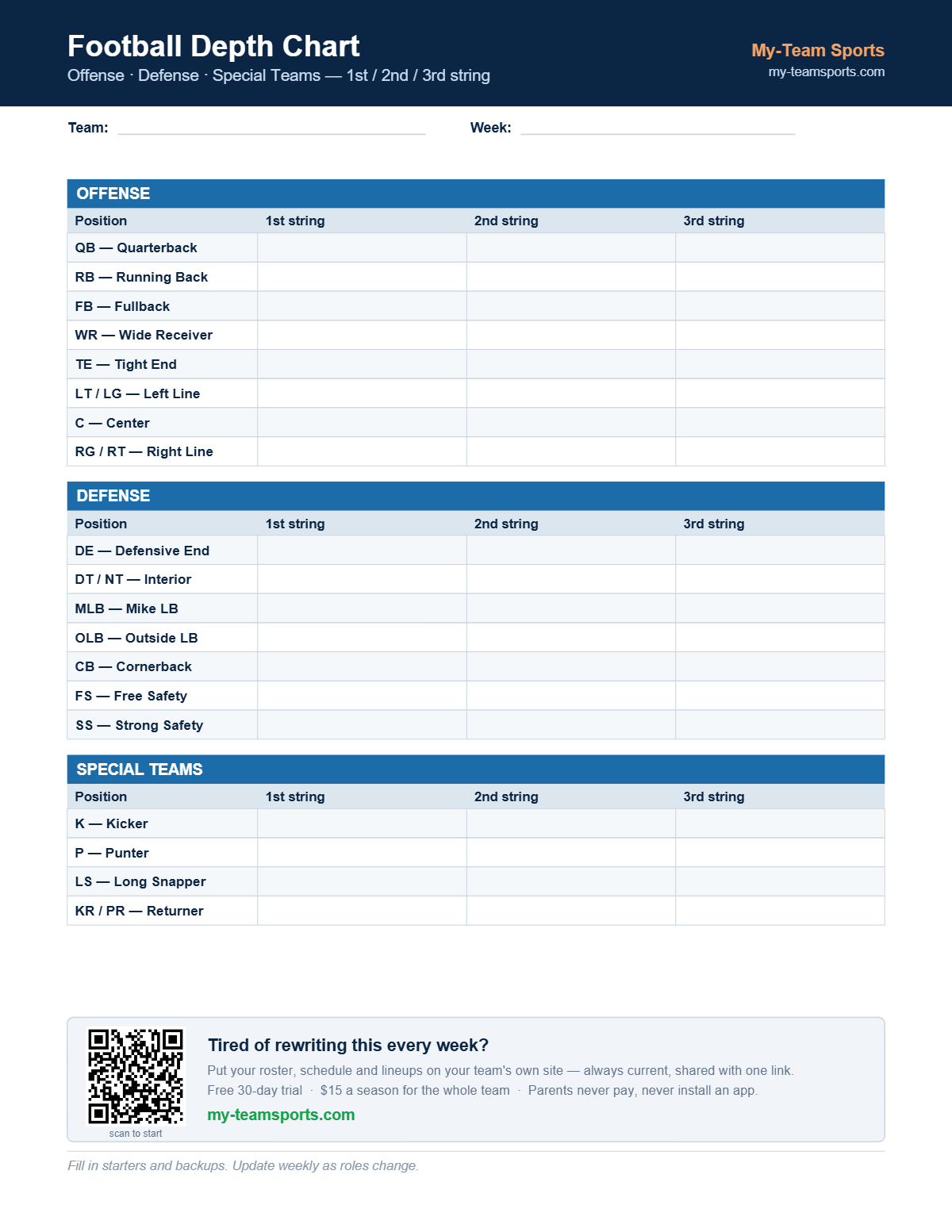
Whether you are a new coach setting a lineup or a parent trying to follow the game, football's positions can look like alphabet soup. Here is every position on offense, defense, and special teams in plain language — plus, for coaches, a quick guide to which kids tend to fit where.
Offense
The offense's job is to move the ball and score. The quarterback (QB) takes the snap and runs the play — put your smartest, most composed player here, not necessarily your best athlete. The running back (RB) carries the ball and blocks, so this wants a strong, decisive runner. A fullback (FB), when used, is a lead blocker and short-yardage runner. Wide receivers (WR) catch passes and need speed and reliable hands. The tight end (TE) is a hybrid who both blocks and catches. Up front, the offensive line — the center (C) who snaps the ball, two guards, and two tackles — protects the quarterback and opens running lanes. Linemen should be your bigger, tougher kids who do not mind contact; footwork matters more than size at the youth level.
Defense
The defense's job is to stop the offense and get the ball back. The defensive line — ends on the edges and tackles or a nose tackle inside — attacks the line of scrimmage. Behind them, linebackers are the defense's engine: they tackle, cover, and blitz, so put active, instinctive kids here. In the back, the secondary — cornerbacks on the outside and safeties in the middle — covers receivers and is your last line of defense, so speed and open-field tackling matter most.
Special teams
Special teams cover kicks and punts and win more youth games than most coaches expect. Key roles are the kicker, punter, long snapper, and kick or punt returners. Do not treat these as afterthoughts — a reliable snapper and a returner who catches cleanly are quietly some of your most valuable players.
How to assign youth players
Start with body type and temperament, then refine by skill. Bigger, physical kids go to the lines; quick, coordinated kids go to skill positions and linebacker; your most composed decision-maker goes to quarterback. Give everyone a real position and rotate early in the season so you discover fits you did not expect — plenty of standout linebackers started the year at guard.
Related coaching tools
Frequently asked questions
What are the football positions by number?
Unlike baseball, football positions are not numbered one through nine. Jersey numbers loosely follow ranges — linemen wear 50 to 79, receivers and backs wear lower numbers — but positions are known by name and abbreviation, not a fixed number.
What is the easiest position for a beginner?
Many new players start at running back, tight end, or on the defensive line, where responsibilities are more contained. Quarterback and cornerback ask the most of a beginner because of decision-making and open-field coverage.
How many players are on the field in youth football?
It varies by league. Many youth programs play 11-on-11, but plenty use 9-on-9 or smaller to fit roster sizes and development goals — check your league's rules.