4-4 Defense Depth Chart Template (Free Printable PDF)
September 12, 2026
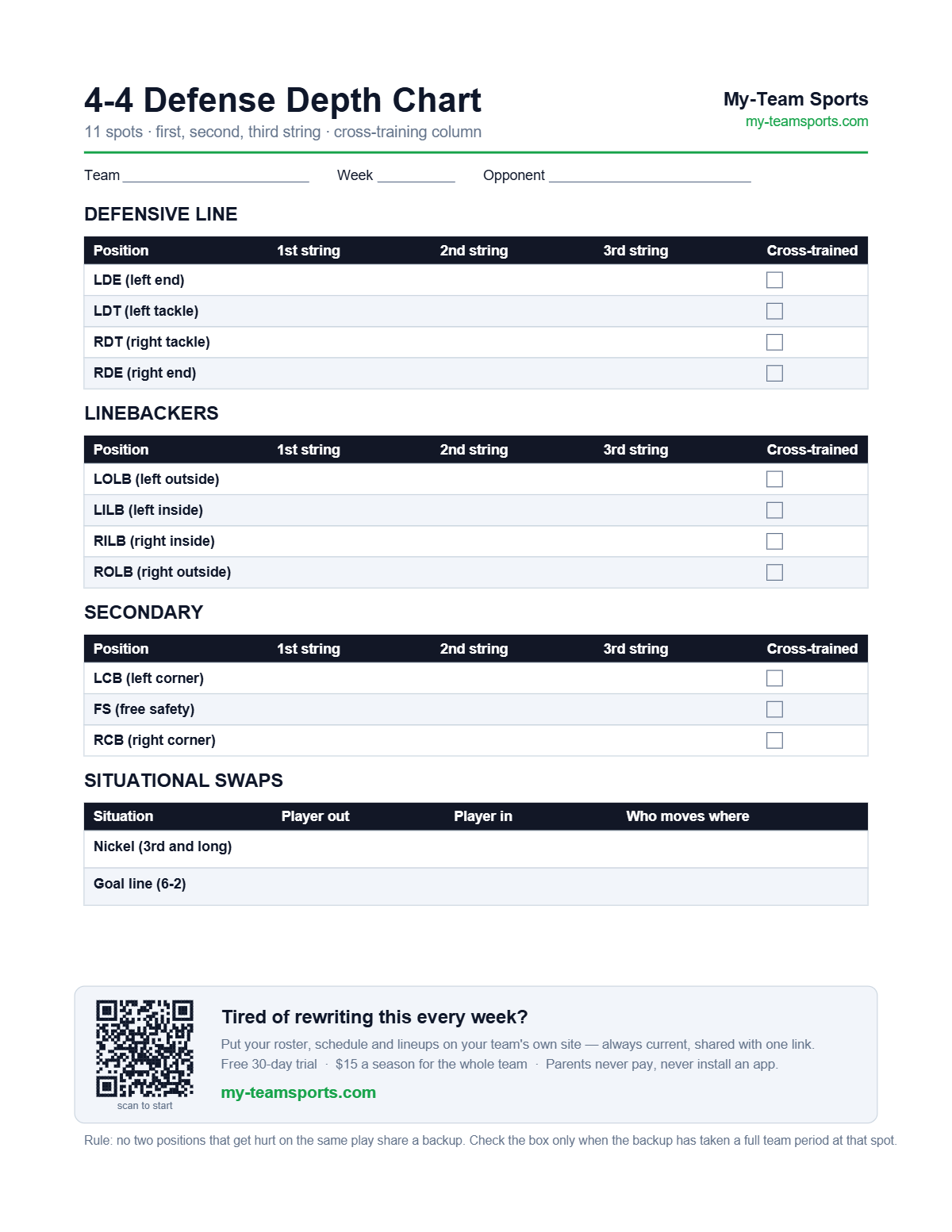
The 4-4 is the youth football default for a reason: eight players in the box, simple run fits, and every linebacker reads the same key. Its weakness is depth. With four linebackers on the field, one injury can shift two other players and change everyone's reads. A depth chart built for the 4-4 — not a generic offense-defense-special-teams sheet — is what keeps that from turning into a mid-game scramble.
The 11 spots in a 4-4
| Position | Count | The job | Who usually fits |
|---|---|---|---|
| Defensive end | 2 | Set the edge, turn everything inside, contain on bootlegs | Long, disciplined players who won't chase the fake |
| Defensive tackle | 2 | Two-gap the guards, eat double teams, stop the dive | Your two biggest linemen who play low |
| Outside linebacker | 2 | Force player against the run, flat coverage against the pass | Athletic kids who tackle in space |
| Inside linebacker | 2 | Read the near back, fill the A and B gaps, call the front | Your smartest players — they run the defense |
| Cornerback | 2 | Deep third or man on the widest receiver, secondary contain | Fast, willing to tackle in the open field |
| Free safety | 1 | Last line of defense, alley player on the run, deep middle | The best tackler you have who can also cover |
How to fill the three strings
First string is the 11 who start. Second string is the first name you would call for each spot — and here is the rule that makes the chart useful: one player can back up two positions, but never two positions that go down together. Your left and right tackle do not share a backup, because a chop block takes both out on the same play. Your two corners do not share a backup for the same reason on a crackback.
Third string is the emergency plan, and at the youth level it is usually a two-way starter coming over from offense. Write that name down anyway. The point of the third column is that you decided before the game, not in the 30 seconds after the trainer waves you over.
The two positions you must cross-train
Inside linebacker and free safety. The inside linebackers make the front call and read the back; the safety is the only player between a missed tackle and the end zone. If your second-string players at either spot have never taken a full practice rep there, the depth chart is a list of names, not a plan. Give both backups a full team period every week — the cross-training column on the PDF is there so you remember who has actually done it.
Nickel and goal-line swaps
You will not stay in a base 4-4 all game. On third and long you probably pull an inside linebacker for a fifth defensive back; inside the five you probably go to a 6-2 with two ends crashing. Write both swaps in the box at the bottom of the chart: which player leaves, which player enters, and who moves. When the down-and-distance comes up, you read it out loud instead of solving it.
The Friday five-minute check
- Cross out anyone who missed a practice this week and confirm the backup below them knows they are one play away.
- Read the two swaps out loud to the players involved so nobody is surprised on Saturday.
- Make sure no two positions that get hurt together share a backup.
- Give a copy to your assistant. The chart on your clipboard does not help if you are down the sideline arguing a spot.
Related coaching tools
Frequently asked questions
What is a 4-4 defense in youth football?
A base front with four down linemen (two ends, two tackles) and four linebackers (two inside, two outside), backed by two cornerbacks and one free safety. It puts eight players near the line of scrimmage, which is why it is so common against run-heavy youth offenses.
How many players are on a 4-4 depth chart?
Eleven starting spots. A complete chart lists a first, second, and third option at every one — 33 names on paper, though at the youth level many of those names repeat because players go both ways.
Can I use this chart for a 4-3 or 6-2?
Yes. Use the swap box at the bottom to note which linebacker becomes a fifth defensive back for the 4-3 nickel look and which ends crash down for the 6-2 goal-line front. Most youth teams run all three out of the same personnel.