Baseball Depth Chart Template (Free Printable PDF)
September 12, 2026
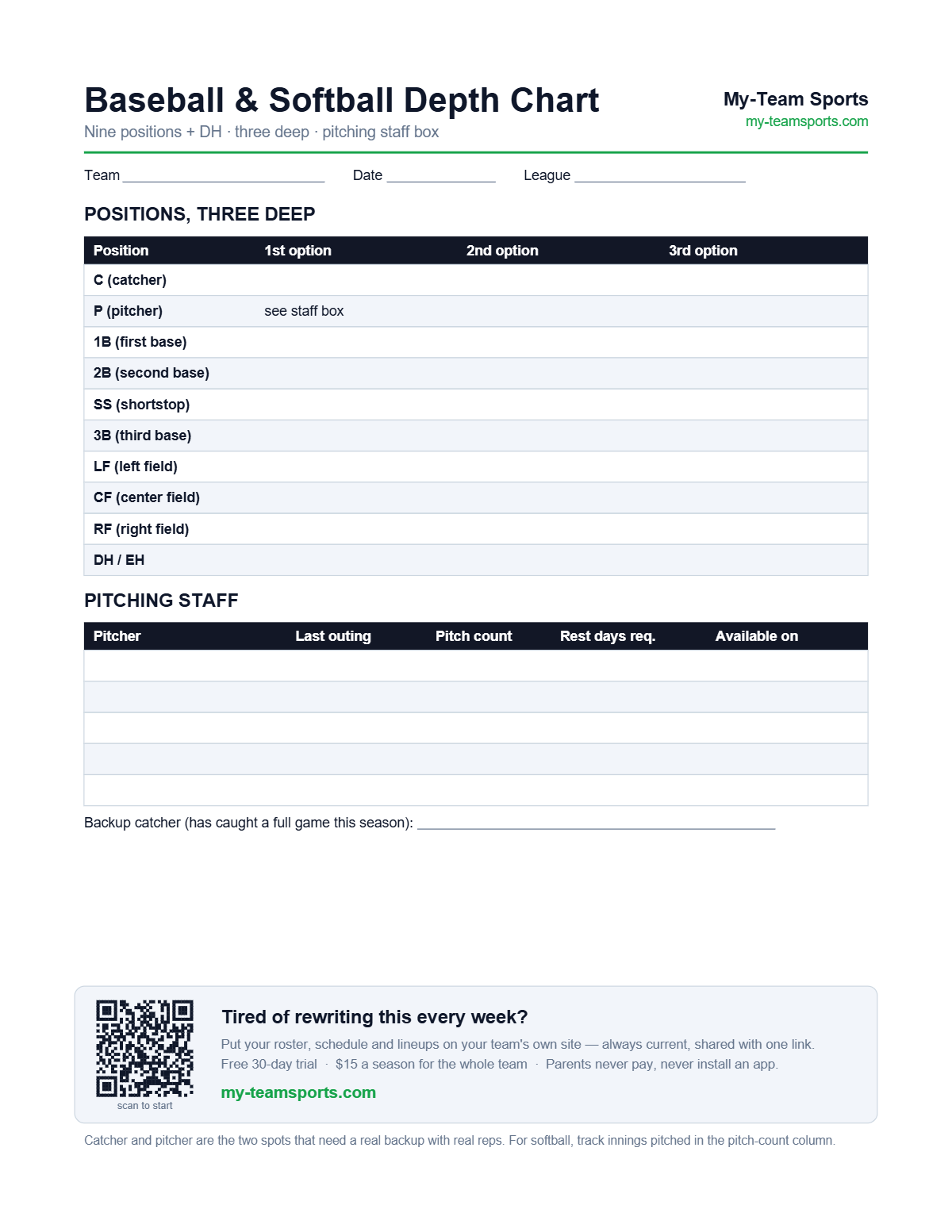
A lineup card tells you who is playing today. A depth chart tells you who plays when today goes sideways — the catcher takes a foul tip off the hand, your starter hits the pitch count in the fourth, the shortstop has a tournament with his travel team. Most youth coaches carry that plan in their head. This sheet puts it on paper so an assistant can run the dugout while you argue a call.
Positions, three deep
| Position | Fill it in this order | Backup rule |
|---|---|---|
| Catcher | 1st | Backup must have caught a full game this season — not a practice |
| Pitcher | 2nd | See the staff box — depth here is a rotation, not a name |
| Shortstop | 3rd | Your best infield arm; backup is usually the second baseman |
| Center field | 4th | Your best outfield range; backup comes from a corner |
| First and third base | 5th | Corners can back each other up — same throws, mirrored |
| Second base | 6th | The easiest infield spot to fill from the bench |
| Left and right field | 7th | Where your developing players get innings without hiding them |
| DH / EH | 8th | The best bat not in the field; write the extra hitter here in leagues that allow it |
The two positions you must have a real backup for
Catcher and pitcher. Everyone else can be covered by moving a competent athlete over for an inning. A backup catcher who has never blocked a ball in the dirt with runners on will cost you a game in one inning, and a pitcher you did not plan for will either throw past his count or be a position player walking the bases loaded. Write both backups down before the season and give them real reps. Everything else on the sheet is a preference; those two are a plan.
Pitch counts change the chart
The pitching staff box has room for each pitcher's pitch count from the last outing and the rest days required. That is not bookkeeping — it is the depth chart for the one position where the rules decide availability. Fill it in after every game and the question of who can pitch Saturday answers itself on Friday.
Using it with your lineup card
- Build the lineup card from the first column, then keep the depth chart on the dugout wall for the game.
- When you substitute, cross out on the depth chart, not the lineup card — the card is the official record and the umpire has a copy.
- Refresh the sheet after every game: who caught, who pitched and for how many pitches, who is unavailable next week.
- For softball, the layout is identical — the pitch-count box works for innings-pitched limits instead.
Related coaching tools
Frequently asked questions
What is a baseball depth chart?
A list of the first, second, and third choice at every defensive position plus a pitching staff plan. Unlike a lineup card, it covers what happens when the starter is unavailable — injury, pitch count, absence — before it happens.
Does this work for softball?
Yes. The nine positions and DH/EH are the same. Use the pitching box to track innings pitched instead of pitch counts if that is what your league limits.
How is a depth chart different from a lineup card?
The lineup card is the official document for one game: batting order and starting positions. The depth chart is the plan behind it — who backs up each spot and who can pitch — and it stays on the dugout wall all season.