Basketball Game Plan Template (Free Printable PDF)
October 7, 2026
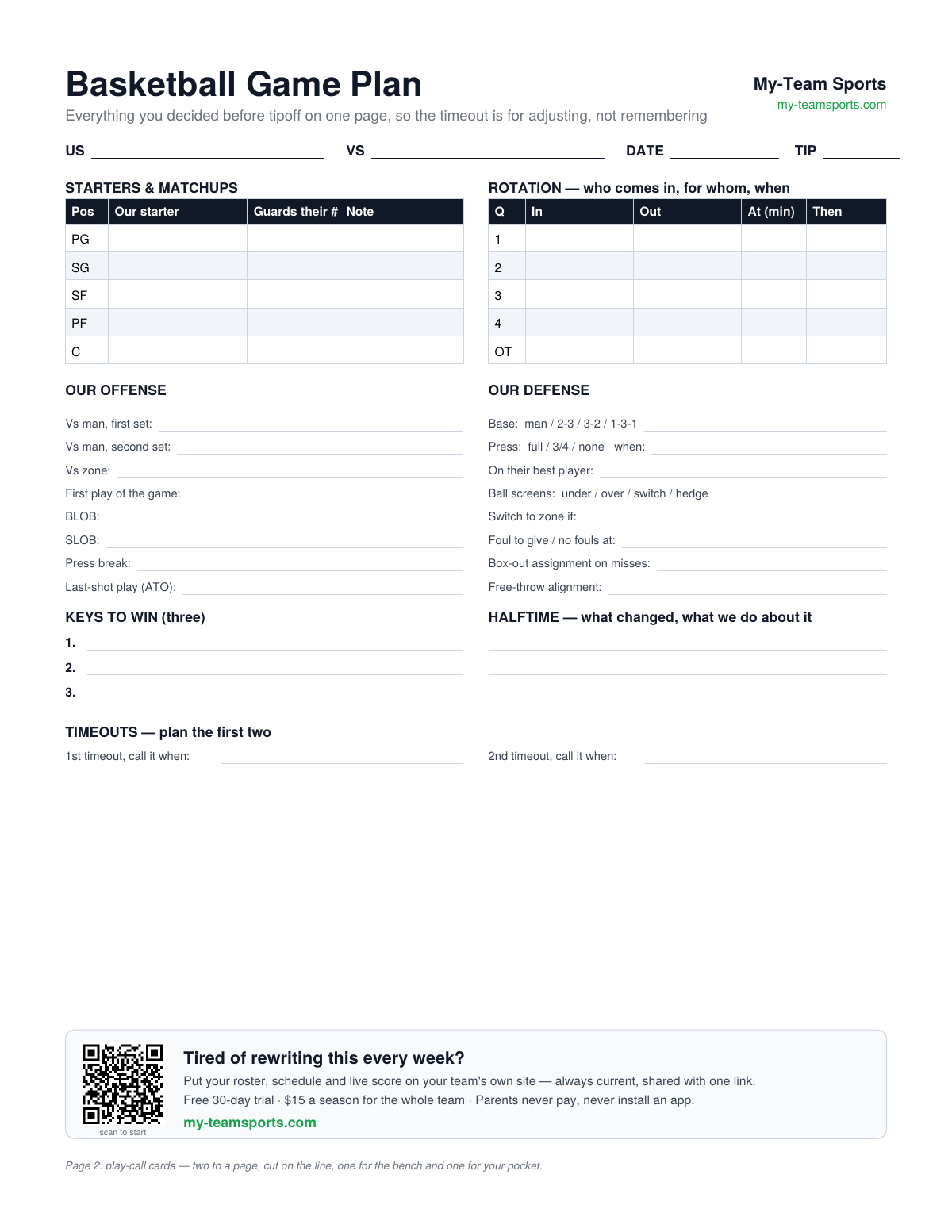
A youth basketball timeout is thirty seconds long and the first fifteen go to getting the kids to look at you. If you are using the other fifteen to remember what you planned, you have no timeout. A game plan is the page where you decided everything before the gym got loud: who starts and who they guard, who comes in for whom and when, what you run against man and against zone, your inbounds plays, your press break, your defense, and the three things that win the game. This printable is that page, with a halftime box and a timeout plan, and a second page of play-call cards you cut in half: one for the bench, one for your pocket.
What goes on the page
| Section | What to decide | Why before the game |
|---|---|---|
| Starters and matchups | Five starters by position and the opponent number each one guards | The matchup is the first thing a kid forgets when the ball goes up |
| Rotation | Who comes in for whom, at what minute, in each quarter | Fair minutes get planned, not improvised; it also stops the parent conversation |
| Our offense | First set against man, second set, what you run against zone, the first play of the game, BLOB, SLOB, press break, last-shot play | Each is a call you make under pressure; write the name you will shout |
| Our defense | Base defense, when you press, who guards their best player, how you handle ball screens, when you switch to zone, where you stop fouling | The things that change mid-game are the things you decided a rule for |
| Keys to win | Three, in order, in words your players can repeat | Pregame huddle, halftime huddle, and the bench sheet |
| Halftime and timeouts | A box for what changed at the half, and when you will call your first two timeouts | The best time to plan a timeout is when nobody is yelling |
The rotation table is the part parents care about
Five rows, one per quarter plus overtime, with who comes in, who comes out, and when. Fill it in before the game and you have done two things: you have guaranteed every kid the minutes you promised in August, and you have a piece of paper to point to when a parent asks. It also protects you from your own instincts. The urge in a close third quarter is to leave the starters in; the rotation table says the bench kid plays four minutes here, and the bench kid plays, and next week he is better for it.
Offense: name the calls, don't describe the plays
The offense lines are for the name you will shout, not a diagram. "Vs man, first set: Horns." "BLOB: Box." "Press break: Line." If you don't have a name for it, you can't call it from the bench and your players can't recognise it. Youth teams need fewer plays with better names, and the page has room for exactly that: two sets against man, one against zone, one baseline and one sideline inbounds play, one press break, one last-shot play. That is a complete youth offense. Draw the plays on the play board; put the names here.
Defense: decide the rules you will need under pressure
Most mid-game defensive decisions are the same every game, so make them once: when you press (after made baskets? only when behind?), how you cover ball screens (go under against a non-shooter, over against a shooter), who guards their best player and whether he gets help, when you switch to zone (foul trouble? they can't shoot?), and the minute after which nobody fouls. The free-throw alignment line is the small one that wins games: decide who boxes out and who leaks out on a missed free throw, because it happens twenty times a game and nobody practises it.
Page 2: play-call cards
Two identical cards on dotted lines, each with slots for half-court sets, zone sets, BLOB, SLOB, press break and after-timeout plays, with a call and a one-line reminder for each. Cut them apart. One goes on the bench where the assistant can see it, one goes in your pocket for the timeout huddle. The reminder line is the coaching point you always forget to say: "Horns: screener rolls, don't pop." Six plays a youth team actually knows beat twenty on a card, so fill the lines you will use and leave the rest blank.
Plan on paper, run the game live
The game plan is for the bench. My-Team Sports runs the rest. Draw and print the sets you named here in the Coach's Playbook, keep the rotation chart alongside the roster on your team's site, score the game live from your phone so the parents who aren't there see it, and let the AI assistant coach turn the stat sheet into Tuesday's practice plan. Print the plan Friday, fill it in Saturday morning, and spend the timeouts coaching.
Related coaching tools
Frequently asked questions
What should a basketball game plan include?
Starters and who they guard, the substitution rotation by quarter, your offensive sets against man and zone with their call names, inbounds plays and a press break, your defensive rules (base defense, press, ball screens, when to switch to zone, when to stop fouling), three keys to win, and a plan for your first two timeouts. One page.
How many plays should a youth basketball team have?
About six: two half-court sets against man, one against zone, a baseline and a sideline inbounds play, and a press break, plus one last-shot play if you want. Fewer plays with clear names and reminders are run better than a long list.
What is a play-call card?
A pocket-sized list of your plays with the call you shout and a one-line coaching reminder for each. The PDF has two on a page with cut lines: one for the bench and one for the coach's pocket for timeouts.
How do you plan substitutions in youth basketball?
Write a rotation table before the game: for each quarter, who comes in, who they replace, and at what minute. It guarantees the minutes you promised, keeps you from leaving starters in out of habit, and gives you something to show a parent who asks.
When should you call a timeout in youth basketball?
Decide the triggers before the game and write them on the plan: a run of six or eight points against you, two turnovers in a row, or a dead ball before a last-shot situation. Pre-deciding means you call it on time instead of two baskets late.