Basketball Scouting Report Template (Free Printable PDF)
October 7, 2026
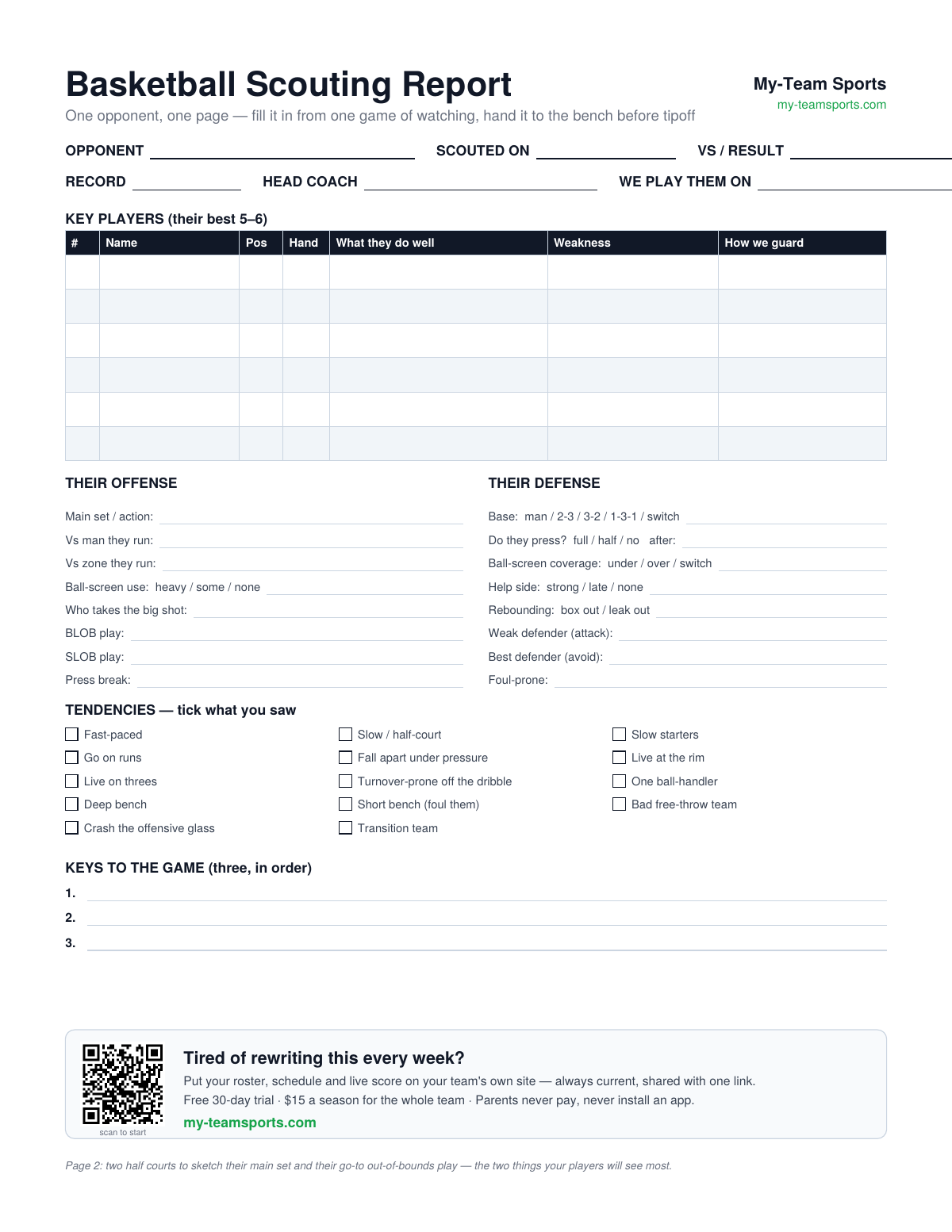
You don't need film to scout a youth basketball team. You need one game of watching with a pen and a page that asks the right questions, and the discipline to only write down what you would tell your players. This printable is that page: their key players and how you guard each one, what they run on offense and how they defend, a checklist of tendencies, and three keys to the game in order. Page 2 is two half courts for the two things your players will see most, their main set and their go-to inbounds play.
How to scout a team in one game
Sit high, not on the baseline, and watch the team, not the ball. For the first quarter write nothing but names and numbers. By the second quarter you will know their best two players and what they want to do; write that down. In the second half, fill in the offense and defense lines and tick the tendencies. If you are scouting from a game your own team is playing, hand the page to an assistant or a parent with a basketball background; the coach never sees the game clearly enough to scout it.
The key players table
| Column | What to write | Example |
|---|---|---|
| Hand | Which hand they drive with. Most youth players have one | Right only |
| What they do well | One thing. The thing they score with | Drives right, pull-up from the elbow |
| Weakness | One thing. The thing they avoid | Won't go left; passes late off the drive |
| How we guard | A sentence your defender can repeat | Force left, hand up on the pull-up, no help needed |
Six rows is plenty. Youth teams run through two or three players; the rest of the report is about those two or three, and your best defender's assignment is the most important sentence on the page.
Their offense and their defense
The offense lines ask what they run against man, what they run against zone, whether they use ball screens, who takes the big shot, and what their baseline and sideline out-of-bounds plays look like. The defense lines ask their base (man, 2-3, 3-2, 1-3-1, or switching), whether and when they press, how they cover ball screens, how good the help side is, and which defender to attack and which to avoid. Circle the options that apply; most lines are a circle and a few words, which is the point. A scouting report your players can't absorb in five minutes before tipoff is a scouting report for you, not for them.
Tendencies: the checklist that wins youth games
The checklist at the bottom is the part most templates skip and the part that decides youth games. Slow starters, go on runs, fall apart under pressure, one ball-handler, short bench, bad free-throw team, crash the offensive glass, transition team. Each ticked box is a decision: one ball-handler means you press; short bench means you make them play fast and foul; bad free-throw team means you foul late instead of letting them run the clock. Tick what you saw, not what you assume, and turn each tick into a key.
Three keys, in order
The three lines at the bottom are the whole report as far as your players are concerned. Write them in order of importance and in words a ten-year-old can repeat back: "Number 5 goes left. Nobody else shoots threes. Box out on every miss." Say them in the huddle before the game, again at halftime, and put the sheet on the bench where you can see it. If you can't get the report down to three keys, you don't have a report yet; you have notes.
Page 2: draw what they run
Two half courts, high-school lines, with note lines under each and a box for what you do about it. Draw their main half-court set on the left and their go-to out-of-bounds play on the right, with their players as O and yours as X. Draw it the way your players see it from the bench, not from the scouting seat. Two plays your team recognises are worth more than ten plays listed in a column, because recognition is what lets a kid be in the right spot before the ball gets there.
Keep the report where the roster lives
Scouting is half of a game plan, and the other half is your own: starters, matchups, rotation, your sets against what they run. The basketball game plan template pairs with this one. In My-Team Sports the Coach's Playbook draws and prints your own sets and inbounds plays for any sport, the roster and schedule live on your team's site, and the AI assistant coach turns a game's stats into a practice plan. Scout on paper, plan on paper, run the season in one place.
Related coaching tools
Frequently asked questions
What should a basketball scouting report include?
Their best players with one strength, one weakness and how you guard each; what they run on offense against man and zone, plus their inbounds plays; their base defense, press and ball-screen coverage; a short list of tendencies; and three keys to the game your players can repeat. One page is the right length.
How do you scout a youth basketball team without film?
Watch one of their games from high in the stands, not the baseline. Write only names and numbers in the first quarter, then their best two players and what they want to do, then the offense and defense lines in the second half. If the game is against your own team, give the sheet to an assistant; the head coach can't scout and coach at once.
How many keys to the game should you give players?
Three, in order of importance, in plain words. More than three and nothing gets remembered. Repeat them before the game and at halftime.
What tendencies matter most at the youth level?
One ball-handler (press them), a short bench (play fast, make them foul), a bad free-throw team (foul late rather than let them run clock), slow starters (press early), and teams that fall apart under pressure. The checklist on the sheet covers these and each tick becomes a decision.
Should you scout at the youth level at all?
Yes, in proportion. One page from one game, three keys for the kids, two plays drawn. That is an hour of work and it changes how the first quarter goes. A ten-page report changes nothing because nobody reads it.