Basketball Score Sheet Template (Free Printable PDF)
October 7, 2026
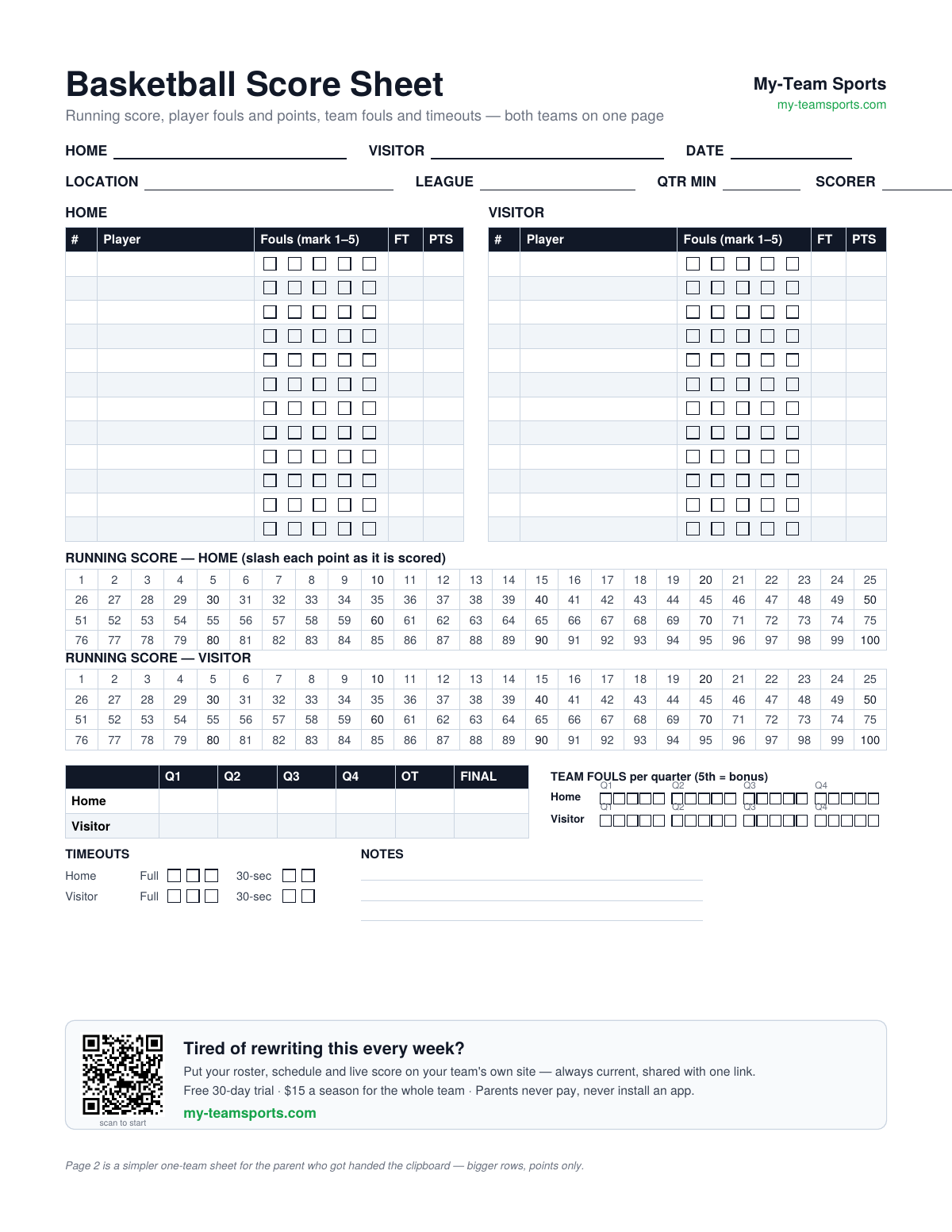
Every youth basketball game needs a score sheet and almost nobody arrives with one. The league's official book stays with the league, the gym's scoreboard resets when a kid leans on the button, and at the end of the game two coaches disagree about the score. This printable fixes that with two pages: a full score sheet with both teams, a running score to 100, player and team fouls, timeouts and quarter scores, and a simpler one-team sheet for the parent who has never kept score before. Print one of each per game.
Which page do you need?
| Page | Best for | Who keeps it |
|---|---|---|
| Full score sheet (page 1) | The scorer's table: both rosters, every foul, the running score that settles arguments, team fouls for the bonus, timeouts left | Whoever sits at the table — a parent with 30 seconds of instruction |
| Simple sheet (page 2) | Your own bench: who scored how much each quarter, who is in foul trouble, running score for your team and theirs | An assistant, an injured player, or the coach between timeouts |
How to keep the running score
The running score is the whole trick, and it is why official scorebooks look the way they do. Every time a team scores, slash the next number in that team's row: a two-point basket crosses out two numbers, a free throw crosses out one. The last number slashed is the score. You never add anything up during the game, you never lose count, and if the scoreboard and the sheet disagree the sheet wins because it has a mark for every point.
Next to the basket, put the player's points in the PTS column as a tally. At the end of the game the tallies in the PTS column must equal the last slashed number in the running score. If they don't, somebody scored a basket that didn't get credited, and that is a thirty-second fix at halftime instead of a mystery on Monday.
Fouls, the bonus, and timeouts
Each player has five boxes. Tick one per foul; when the fifth box is ticked the player is done, and the person keeping the sheet should say so out loud, because referees forget. Team fouls go in the quarter boxes below: in most youth leagues the fifth team foul in a quarter puts the other team in the bonus (two free throws on every foul), and the coach who knows the count is the coach who stops fouling at four. Timeouts are the boxes nobody tracks until the last minute, when it matters most; tick them as they are called.
| Situation | What to mark | Why it matters |
|---|---|---|
| Made basket | Slash 2 (or 3) numbers in the running score, tally in PTS | Score is always the last slashed number |
| Free throw made | Slash 1 number, tally 1 in PTS | Same rule, one point |
| Personal foul | Tick the next box for that player, tick the team-foul box for the quarter | Five = out; team's fifth per quarter = bonus |
| Timeout | Tick full or 30-second for that team | Knowing you have none left changes the last play |
| End of quarter | Write the quarter score in the box | Shows which quarter the game turned |
The simple sheet, for the bench
Page 2 drops everything the table needs and keeps what the bench needs: one team, fourteen rows, five foul boxes, points by quarter, and both running scores. Hand it to an assistant with one sentence: tally the points in the quarter box as they happen. At the end of the quarter the totals go across, and you know at a glance who is carrying the scoring and who has three fouls before halftime. The quarter columns are the useful part. A kid who scores eight in the first and nothing after is a different conversation than a kid who scores two a quarter.
Score it live instead
The sheet is for the table. My-Team Sports is for everyone who isn't in the gym. The live basketball scoreboard runs from your phone with 1, 2 and 3-point buttons, period by period, and parents who open your team's site see the score as it happens. Points credited to a player go straight into the Stats tab, where points, rebounds, assists, steals and blocks add up over the season. Print the sheet for the official book, score it live for the family in the car.
Related coaching tools
Frequently asked questions
How do you fill out a basketball score sheet?
Write both rosters with jersey numbers before tipoff. When a team scores, slash the next number(s) in that team's running score and tally the points next to the player. Tick a foul box for the player and the team-foul box for the quarter on every personal foul. Tick timeouts as they are called and write each quarter's score in the quarter box at the break.
What is a running score in basketball?
A row of numbers from 1 to 100 (or more) for each team. Each point scored crosses out the next number, so the last crossed-out number is always the current score. It is how official scorebooks work and it means you never add during the game.
How many fouls before a player fouls out in youth basketball?
Five personal fouls in most youth and high-school leagues (six in the NBA). The sheet has five boxes per player; when the fifth is ticked the player is done, and the scorer should tell the referee.
When is a team in the bonus?
It depends on the league. Under current high-school rules the fifth team foul in a quarter puts the opponent in the bonus with two free throws; older rules use the seventh foul in a half for one-and-one and the tenth for two shots. Check your league and use the team-foul boxes to count.
Can a parent keep the score sheet?
Yes, and they usually do. The simple sheet on page 2 needs one instruction: tally the points in the quarter box when they happen. The full sheet on page 1 takes about a minute to explain and is the one to use at the scorer's table.