Basketball Stat Sheet Template (Free Printable PDF)
October 7, 2026
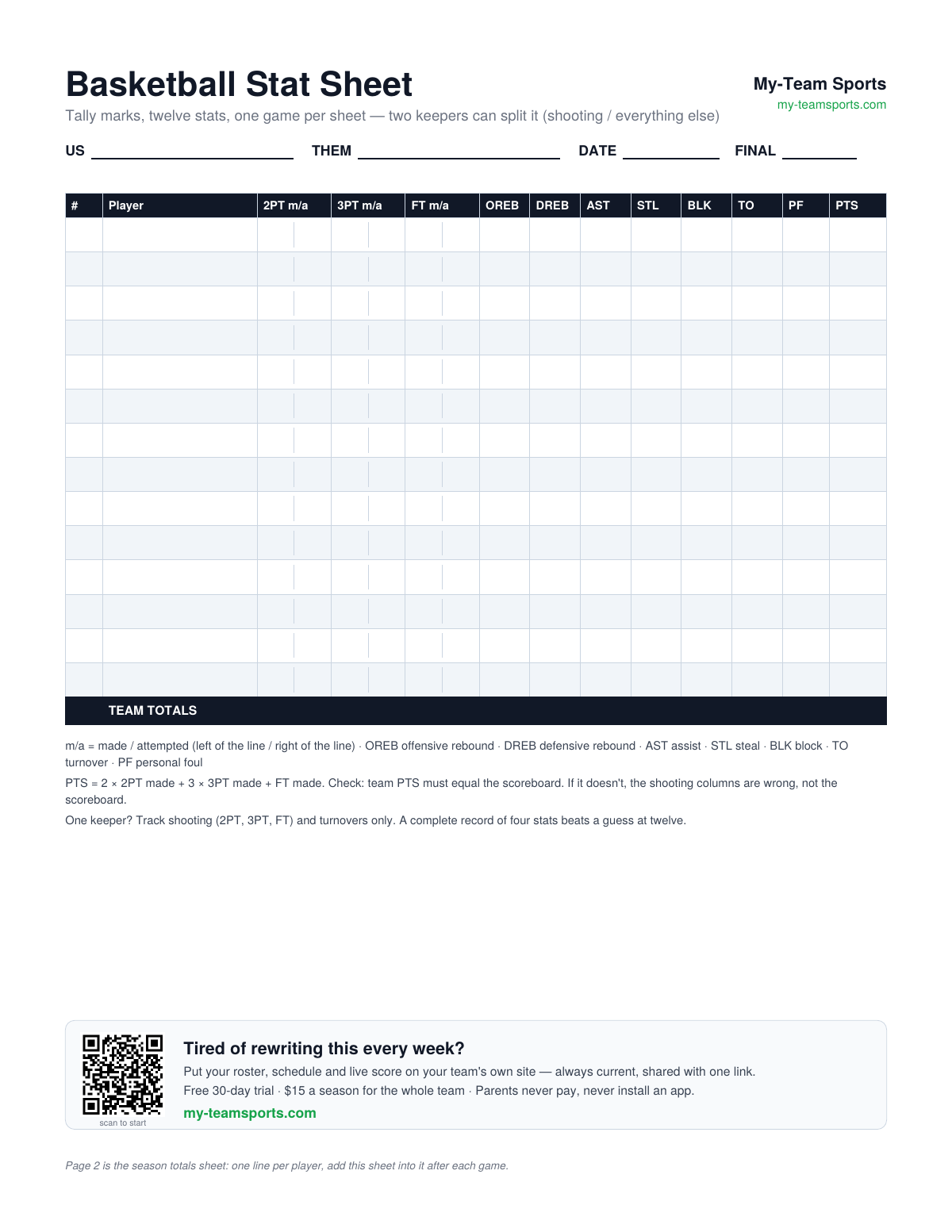
A stat sheet is only useful if it gets filled in every game, and most of them don't, because they ask one parent to track fifteen things at once. This one is built to be split. The shooting columns (2-point, 3-point and free throws, made and attempted) are one job; rebounds, assists, steals, blocks, turnovers and fouls are the other. Two keepers and you have a real box score. One keeper, and the sheet tells you which four columns to keep and which to let go. Page 2 is the season totals sheet with the three derived numbers that actually tell you something.
What's on the game sheet
| Column | What to mark | Who keeps it |
|---|---|---|
| 2PT m/a, 3PT m/a, FT m/a | A tally on the left of the line for every make, on the right for every attempt (makes count as attempts too) | Keeper 1: shooting only, eyes on the ball |
| OREB / DREB | A tally when a player grabs a miss: offensive if it was our shot, defensive if theirs | Keeper 2 |
| AST, STL, BLK | Tally. Assist = the pass before a made basket; steal = takes it from a dribbler or passing lane; block = deflects a shot | Keeper 2 |
| TO, PF | Turnover = we lose it without a shot; PF from the referee's signal | Keeper 2 |
| PTS | Add it at the break: 2 × 2PT made + 3 × 3PT made + FT made | Either, at halftime and the end |
One keeper? Track four things
If you only have one parent on the bench, do not try to fill every column. Keep the three shooting columns and turnovers, and leave the rest blank. Shooting tells you where your points come from and whether the problem is shot selection or finishing; turnovers tell you whether you got to shoot at all. Those four columns kept every game are worth more than twelve columns kept twice. The footer on the sheet says the same thing, because every coach needs reminding of it in week three.
The check that catches mistakes
Add the PTS column. It has to equal the scoreboard. If it doesn't, somebody's basket was marked in the wrong row, or a three was marked as a two, and you can usually find it in a minute at halftime while the players are getting water. Do this check every game and your season totals will be right; skip it and by January nobody trusts the sheet.
Season totals and the three numbers worth working out
Page 2 has a row per player and the columns to add each game sheet into: games played, field goals made and attempted, threes, free throws, rebounds, assists, steals, turnovers and points. The last two columns are the ones to actually talk about.
| Number | How | What it tells you |
|---|---|---|
| FG% | FGM ÷ FGA | Youth teams live between 30% and 40%. Under 30% is usually shot selection, not shooting form — check the shot chart before you run a shooting drill |
| PPG | PTS ÷ GP | Compare it with minutes, not with the other players. A 4-point kid playing 8 minutes may be your most efficient scorer |
| AST ÷ TO (team) | Team assists ÷ team turnovers | Above 1.0 means the ball is moving. Below 0.7 means the offense is a dribble and a prayer. It moves faster than any other number once you work on it |
Resist the urge to add columns. A column with gaps is worse than no column, because it looks like data and isn't. If the sheet gets kept every game with four stats, add a fifth in December.
Or let the totals add themselves
The paper sheet is the bench copy. In My-Team Sports the Stats tab is a grid: enter points, rebounds, assists, steals and blocks per game, and the season totals, games played and per-game averages compute themselves and show on your team's site for parents. Score the game live from your phone and the points credited to each player land in the same place. Print the sheet, keep it in the gym, type the five numbers in on the drive home.
Related coaching tools
Frequently asked questions
What stats should you keep for youth basketball?
If you have one person: field goals made and attempted (2-point and 3-point), free throws made and attempted, and turnovers. Those tell you where points come from and whether you got to shoot. With two keepers add rebounds, assists, steals, blocks and fouls. Points are computed from the shooting columns.
How do you keep basketball stats with tally marks?
Each shooting column is split by a line: a mark on the left for a make, a mark on the right for every attempt (a make is also an attempt). Other columns get one mark per event. Total between quarters, and check that the points column equals the scoreboard.
How do you calculate field goal percentage?
Field goals made divided by field goals attempted, including both 2-point and 3-point shots. 12 makes on 30 attempts is 40%. Free throws are not field goals and are tracked separately.
What is a good field goal percentage for a youth basketball team?
Most youth teams fall between 30% and 40% over a season. Below 30% usually means too many long two-point shots rather than bad shooters; pair the stat sheet with a shot chart to tell the difference.
What is an assist-to-turnover ratio and what should it be?
Team assists divided by team turnovers. Above 1.0 is healthy for a youth team and means the ball is moving to open players; below 0.7 means possessions end in a dribble and a bad shot or a turnover. It is the quickest number to improve with passing drills and a simple offense.