Basketball Tryout Evaluation Form (Free Printable PDF)
August 24, 2026
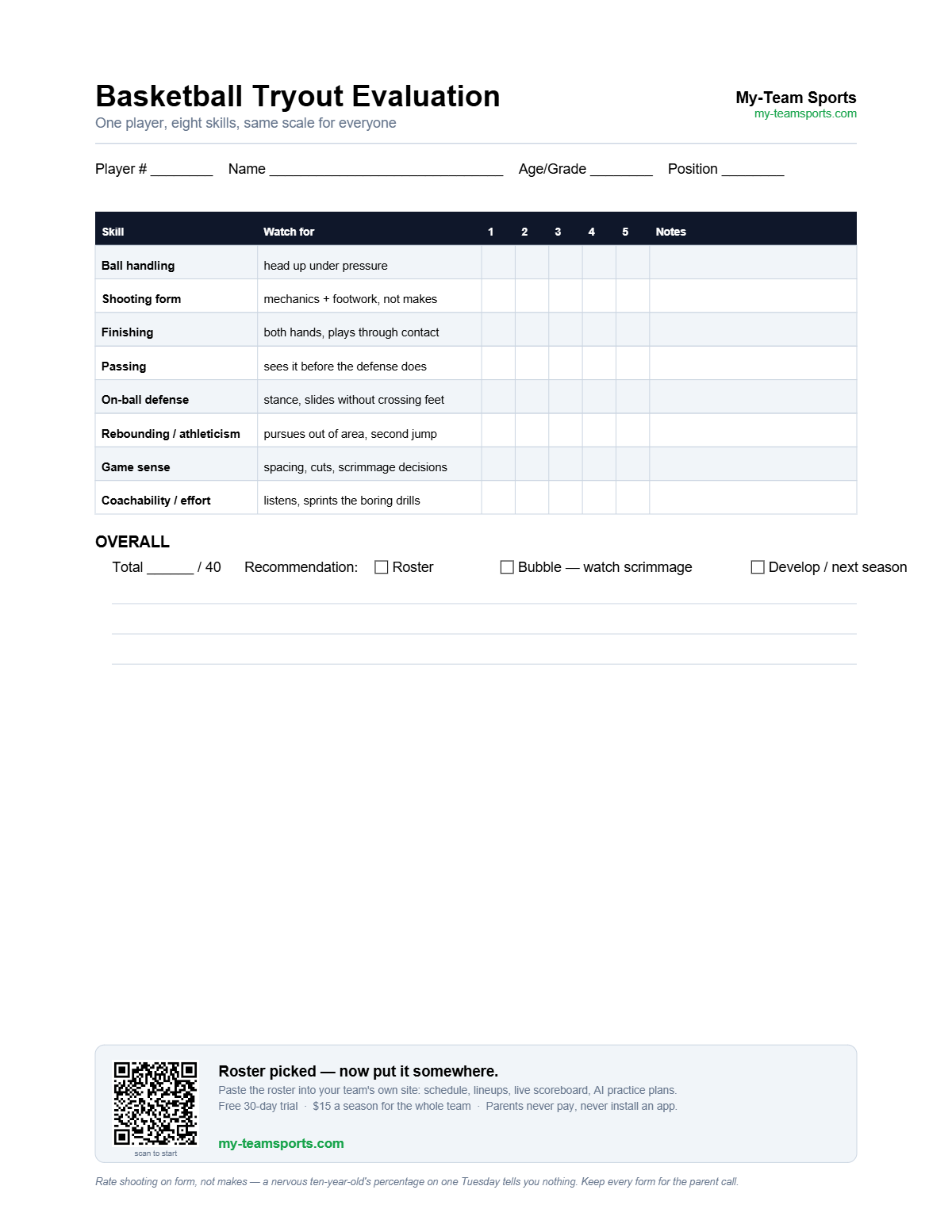
The hardest conversation in youth basketball isn't with a player — it's with a parent who wants to know why their kid didn't make it. A tryout evaluation form is how that conversation stays short and fair: every player rated on the same skills, by the same scale, on paper you still have in March. This free printable gives you a full single-player form plus a grid for scoring a whole gym.
The eight things to rate
| Skill | What to watch for |
|---|---|
| Ball handling | Head up under pressure — not the crossover, the eyes |
| Shooting form | Mechanics and footwork, not whether it went in today |
| Finishing | Both hands at the rim, contact doesn't end the play |
| Passing | Sees the open teammate before the defense does |
| On-ball defense | Slides without crossing feet, stays down in a stance |
| Rebounding & athleticism | Pursues the ball out of area; second jump |
| Game sense | Spacing, cuts, decisions in scrimmage — the unteachable tell |
| Coachability & effort | Eye contact during instruction, sprints in the boring drills |
Run the tryout so the numbers mean something
The form is only as fair as the tryout underneath it. Number every player with tape or pinnies so evaluators score jerseys, not names. Run the same station sequence for every group — handling, shooting, defense, then scrimmage — so player twelve gets judged on the same drills as player one. And use at least two evaluators scoring independently; where your sheets disagree is exactly where to watch the scrimmage closer. Rate shooting on form, not makes: a nervous ten-year-old's percentage on one Tuesday tells you nothing, but their footwork does.
After the last whistle
Total the scores, sort the grid, and make the easy calls first — the top group and the clear cuts. Spend your time on the middle, and let game sense and coachability break the ties; skills catch up to attitude, rarely the reverse. Then keep every form. When a parent calls, you're reading from the same sheet every kid was scored on — and next season, the kid who missed the cut gets a specific answer about what to work on instead of a shrug.
Roster picked — now put it somewhere
The day after tryouts, the real season admin starts. With My-Team Sports, you paste the roster in, the schedule goes up on a team site parents open like an app, the live scoreboard covers game night, and the AI assistant coach builds practice plans around exactly the gaps the tryout exposed. The form finds the team; the site runs it.
Related coaching tools
Frequently asked questions
What should a basketball tryout evaluation form include?
Player identification (number, name, age or grade), a consistent rating scale — 1 to 5 works — across a fixed set of skills like ball handling, shooting form, finishing, passing, defense, rebounding, game sense, and coachability, plus space for notes and an overall recommendation.
How do you score basketball tryouts fairly?
Same drills for every group, numbered players so evaluators score jerseys rather than reputations, at least two evaluators scoring independently, and ratings anchored to what you watched — form and decisions — rather than makes and misses on one nervous afternoon. Keep the forms afterward so decisions are documentable.
How many evaluators do you need for a tryout?
Two is the practical minimum — independent scores catch personal bias, and where they disagree tells you who to watch in the scrimmage. For big tryouts, one evaluator per station plus one floating on scrimmage play works well with the multi-player grid.