Basketball Tryout Plan Template (Free Printable PDF)
September 12, 2026
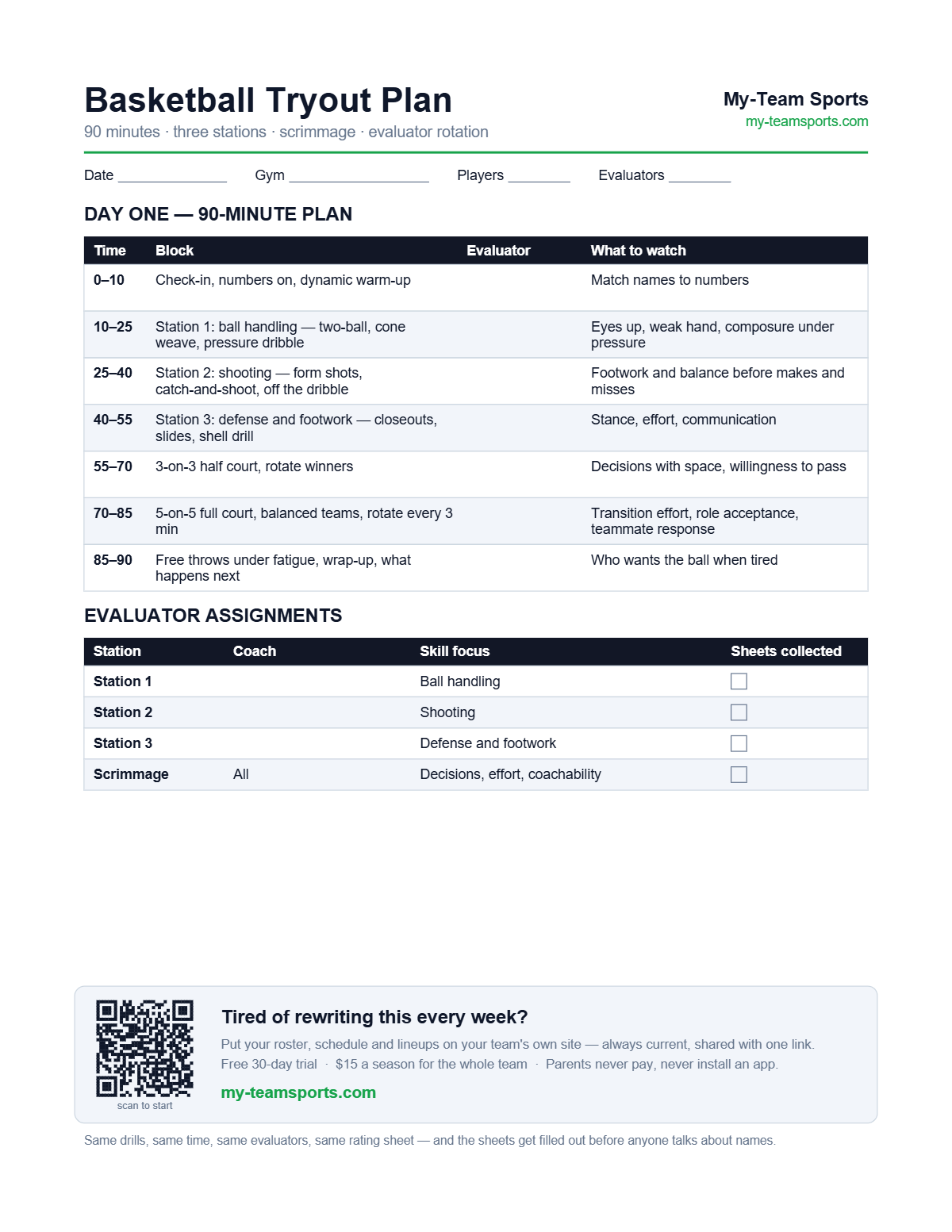
A tryout is the one practice all season where the outcome has to be defensible. The way you make it defensible is not a better eye — it is a plan that shows every player the same drills, for the same amount of time, in front of the same evaluators. This 90-minute plan does that with six timed blocks. Run it on day one, use the blank second page to adjust for day two, and the roster decisions will explain themselves.
The 90-minute plan
| Time | Block | What evaluators watch |
|---|---|---|
| 0–10 | Check-in, numbers on, dynamic warm-up | Nothing yet — get names matched to numbers |
| 10–25 | Station 1: ball handling (two-ball, cone weave, pressure dribble) | Eyes up, weak hand, composure when a defender closes |
| 25–40 | Station 2: shooting (form shots, catch-and-shoot, off the dribble) | Footwork and balance before makes and misses |
| 40–55 | Station 3: defense and footwork (closeouts, slides, shell drill) | Stance, effort, communication — the things that cannot be taught by December |
| 55–70 | 3-on-3 half court, rotating winners | Decision making with space, willingness to pass |
| 70–85 | 5-on-5 full court, balanced teams | Transition effort, role acceptance, how they treat a teammate's mistake |
| 85–90 | Free throws under fatigue, wrap-up, what to expect next | Who wants the ball when they are tired |
Stations, not lines
Split the gym into three stations and rotate groups of eight to ten every 15 minutes. Two things happen: every player gets three times the reps they would get in a single line, and each evaluator sees every player doing the same drill in the same window. If you have one coach, run the stations in sequence for the whole group instead and keep the timing — consistency matters more than parallelism.
Assigning evaluators
Give each evaluator one station and one skill set for the drill blocks, then have everyone score the scrimmage. A coach who only watches ball handling for 15 minutes rates it far more consistently than one trying to score eight skills at once. Use the same rating sheet for every player — the tryout evaluation form linked below is built to sit next to this plan — and collect the sheets before anyone talks about players.
The scrimmage answers the questions drills cannot
Drills tell you who can shoot. Scrimmages tell you who will pass to the open player, who sprints back on defense, and who says something to a teammate after a turnover. Balance the teams on purpose so a good player is not hidden on a bad team, and rotate every three minutes so no one sits. This is where the middle of your roster gets decided.
Day two
- Shorten stations to ten minutes and lengthen the scrimmage — you have seen the skills, now watch the decisions.
- Move the players you are unsure about onto the same team so they are compared directly.
- Run one new drill nobody has seen. Coachability shows up in the first three reps of something unfamiliar.
- Post cut decisions the same way for everyone, with the rating sheet available to any parent who asks.
Related coaching tools
Frequently asked questions
How long should a basketball tryout be?
Ninety minutes is enough to see three skill stations and a full scrimmage without fatigue distorting the results. Run two sessions on separate days if you have more than about 30 players or a hard roster limit.
What drills should a basketball tryout include?
One ball-handling block, one shooting block, one defense and footwork block, then 3-on-3 and 5-on-5 play. Keep the drills simple — you are evaluating the player, not their ability to learn a complicated drill in two minutes.
How do you evaluate players fairly at a tryout?
Same drills, same time, same evaluators, same rating sheet, and the sheet gets filled out before anyone discusses names. The plan handles the first four; the evaluation form handles the fifth.