Hockey Shift Chart Template (Free Printable PDF)
August 7, 2026
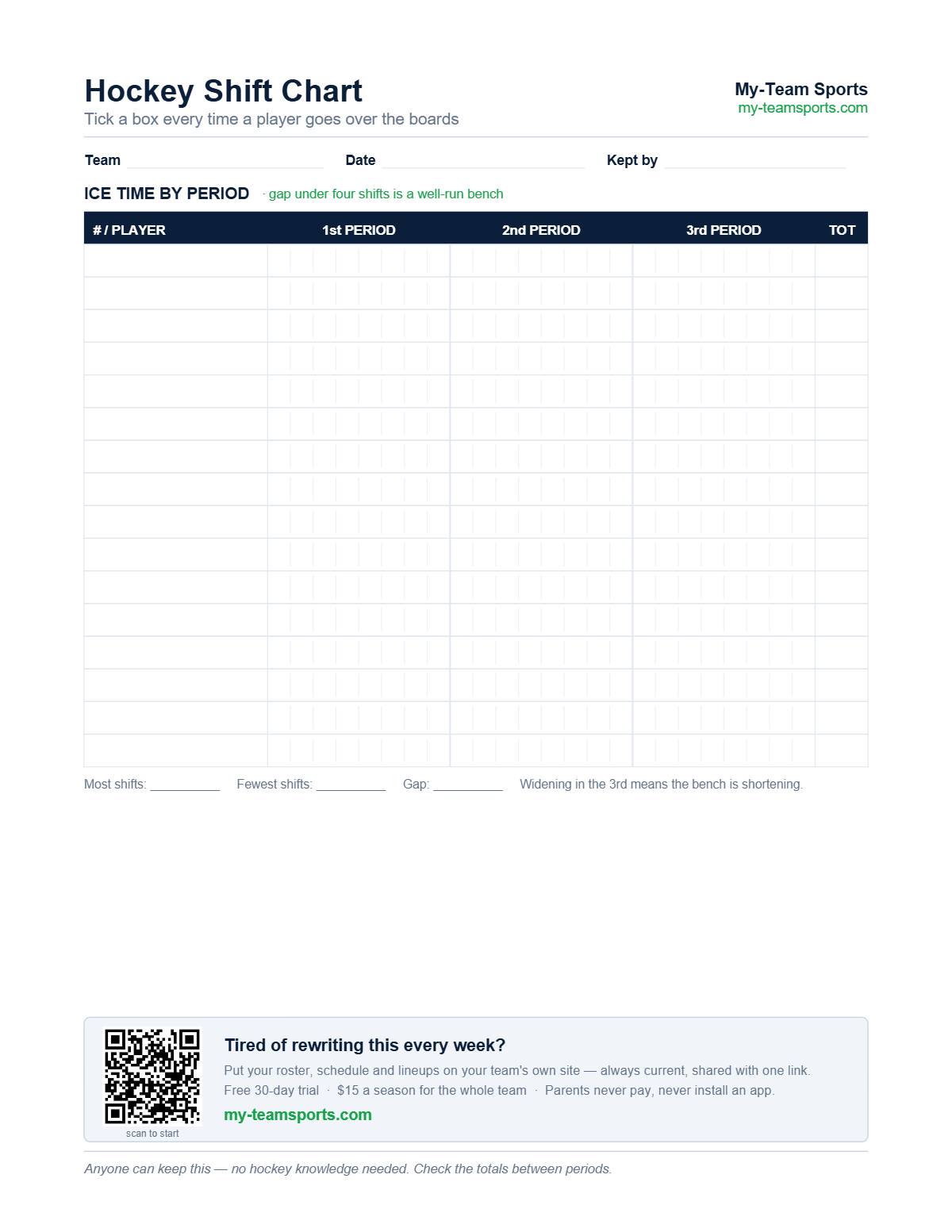
Ask any youth hockey coach whether ice time is even across the roster and they will say yes. Ask them to prove it and the conversation changes. This free printable shift chart is the proof: a grid where a parent or assistant marks each player's shifts through all three periods, so at the buzzer you know exactly who played and who did not.
What is on the sheet
Every player down the left side, with a row of shift boxes for each period and a totals column at the far right. One person on the bench — an assistant, a parent, a sibling old enough to pay attention — puts a tick in the box each time a player goes over the boards. That is the whole system. It takes no hockey knowledge to run, which is exactly why it gets run consistently.
Why the tally beats your memory
Ice time drifts without anyone intending it. A line gets a power play, then the shift right after, then the coach leaves them out because the puck is in the offensive zone and a change feels risky. Three of those in a period and one line has played half again as much as another, and nobody on the bench noticed — least of all the coach, who was watching the puck.
The chart makes the drift visible while you can still fix it. Glance at the totals between the second and third period and you know who to double-shift and who to sit for a rotation, before the game ends and the math becomes an argument.
Reading it after the game
Two numbers matter. The gap between your most-played and least-played skater tells you whether the rotation held: inside three or four shifts is a well-run bench, anything past six or seven and a kid on your team knows they are being benched even if you have not said so. The second is the trend across periods — if the spread widens in the third, you are shortening the bench under pressure, which is the single most common habit that drives families out of youth hockey.
From the clipboard to the team page
The chart lives on the bench, but the season lives somewhere else. If you run your team on My-Team Sports, the roster, the schedule with rink addresses and RSVPs, the live score by period, and your season stats all sit on one page that parents open with a link and a passcode — no app, no account, and no charge to them ever. Print this sheet for the bench and let the site handle everything after the handshake line.
Related coaching tools
Frequently asked questions
How do you track ice time in youth hockey?
The simplest reliable method is a paper shift chart: list the roster down one side and tick a box each time a player goes over the boards, with a column per period. It needs no hockey knowledge to run, so an assistant or a parent can keep it every game.
How much ice time should a youth hockey player get?
At the developmental levels the goal is roughly even shifts across all skaters. A practical benchmark is keeping the gap between your most-played and least-played skater inside three or four shifts per game.
What is a fair way to handle a shortened bench?
Decide before the game rather than in the third period. If you plan to shorten the bench in a specific situation — a late penalty kill, for example — say so to the team beforehand so it reads as a role, not a benching.
Does a shift chart work for house league and travel teams?
Yes. House leagues often carry a minimum-play rule the chart documents directly, and travel teams use it to catch the ice-time drift that happens when special teams and momentum start driving line changes.