Youth Soccer Formations by Age: 7v7, 9v9, and 11v11 (Printable)
August 3, 2026
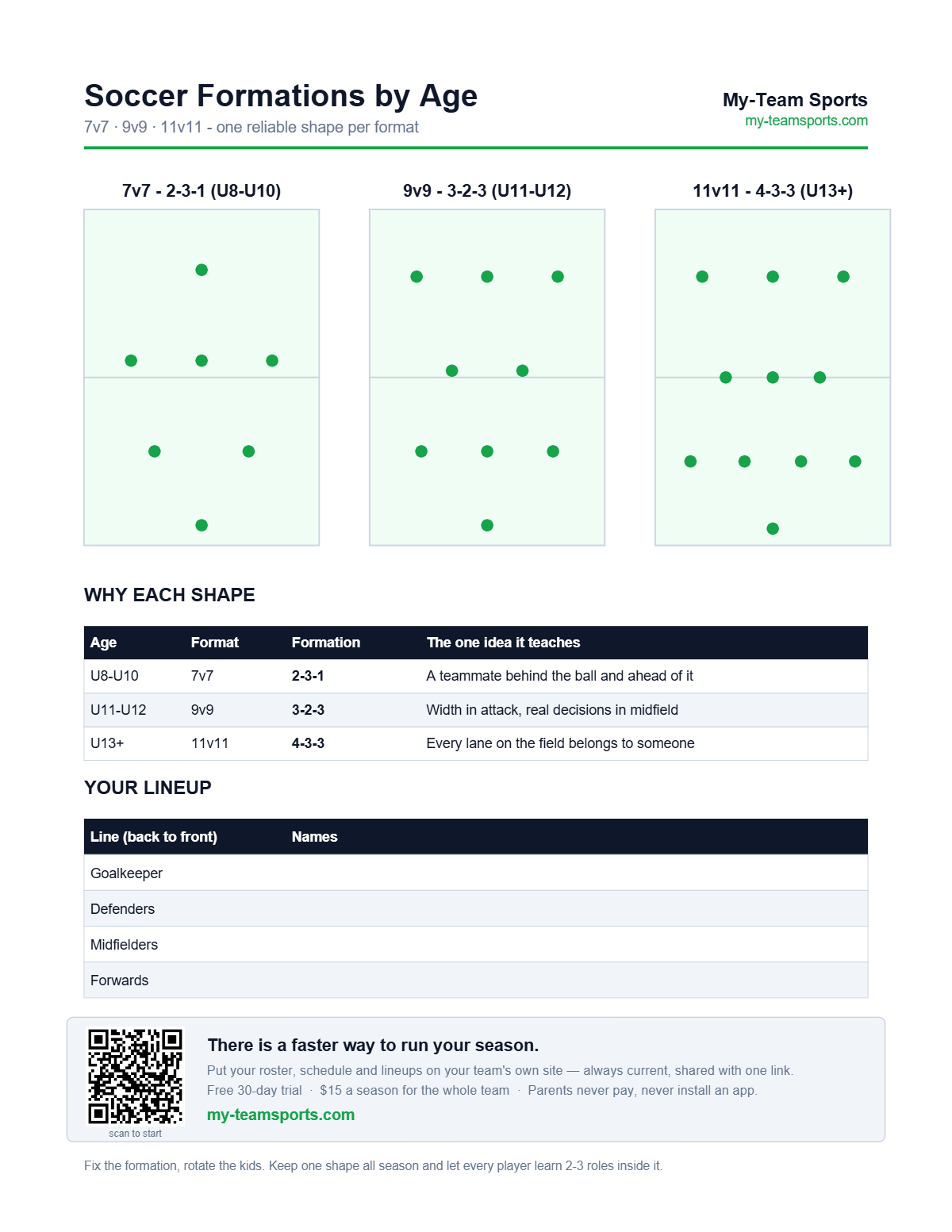
Youth soccer changes formats as kids grow — 7v7 around U8-U10, 9v9 at U11-U12, full 11v11 from U13 — and every format change resets the question of where everyone should play. The honest answer: at these ages the formation is a teaching tool, not a tactic. Pick one reliable shape per format, keep it all season, and spend your energy rotating kids through it.
7v7 (U8–U10): play a 2-3-1
Two defenders, three across the middle, one striker. The 2-3-1 gives young players the two concepts that matter at this age — a teammate behind the ball and a teammate ahead of it — without asking anyone to understand offside traps. The wide midfielders do most of the running, so that's where restless legs go. Resist the 3-2-1 with a sweeper: it wins a few more games and teaches a lot less.
9v9 (U11–U12): play a 3-2-3
Three defenders, two central midfielders, three forwards. This is the bridge format — the 3-2-3 introduces real width in attack and asks the two central mids to make actual decisions: who presses, who covers. If your team gets overrun in midfield, a 3-3-2 is the safer version of the same idea. Either way, keep the back three flat and coach your defenders to step, not just drop.
11v11 (U13+): start from a 4-3-3
Four defenders, three midfielders, three forwards. The 4-3-3 is the easiest full-field shape to teach because every lane on the field belongs to someone, and it converts cleanly to the 4-4-2 or 4-2-3-1 they'll meet on older teams. Number the roles before you name kids: it's easier to say "we need a 6 who wins the ball" than to reshuffle personalities in midseason.
The age-to-format cheat table
| Age group | Format | Formation | Field players per kid concept |
|---|---|---|---|
| U8–U10 | 7v7 | 2-3-1 | Behind the ball / ahead of the ball |
| U11–U12 | 9v9 | 3-2-3 (or 3-3-2) | Width in attack, decisions in midfield |
| U13+ | 11v11 | 4-3-3 | Every lane owned, numbered roles |
Put the lineup where everyone sees it
A formation only helps if the kids know where they're standing before the whistle. Pair the diagram sheet with a lineup that parents can see: on My-Team Sports your roster, schedule, and game-day lineup live on one team site parents open like an app — no group-text archaeology at 8am Saturday. Set the shape once, post the lineup, and coach the game instead of the sideline.
Related coaching tools
Frequently asked questions
What is the best formation for 7v7 youth soccer?
A 2-3-1 — two defenders, three midfielders, one striker. It guarantees support behind the ball and a target ahead of it, which are the only two positional ideas most U8-U10 players are ready to use.
What formation should a 9v9 team play?
Start with a 3-2-3. It adds real attacking width and asks the central midfielders to make genuine decisions. If you're getting overrun in the middle, a 3-3-2 trades a forward for another midfielder without changing the ideas underneath.
Should young players have fixed positions?
No — fix the formation, rotate the kids. Keeping one shape all season gives the team stability while every player learns two or three roles inside it. Fixed positions before U13 mostly optimize for this Saturday at the cost of development.