Baseball Pitch Count Tracker Template (Free Printable PDF)
October 17, 2026
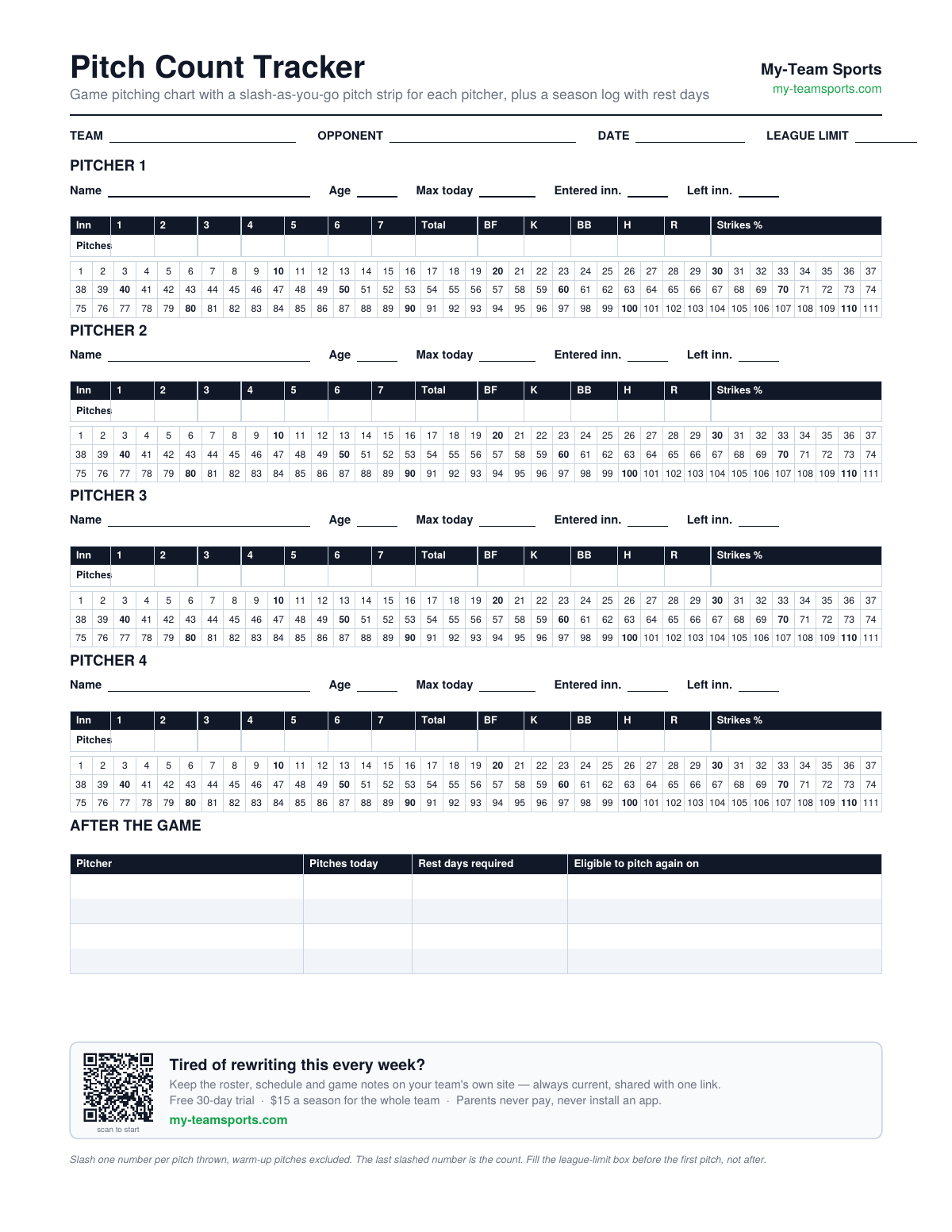
Every youth league now has pitch-count rules, and every coach has been asked mid-game how many pitches his kid has thrown and had to guess. This printable ends the guessing. Page 1 is a game pitching chart for up to four pitchers, each with a strip of numbers from 1 to 110: slash one per pitch, and the last slashed number is the count, the same trick a basketball running score uses. Page 2 is a season log — one row per outing with the limit, the rest days required and the date the pitcher is eligible again — plus a table to copy your league's limits into, because Little League, PONY, Cal Ripken, USSSA and high school all differ.
How to use the game chart
Before the first pitch, write the league limit for each pitcher's age in the Max today box. During the game, slash the next number on that pitcher's strip on every pitch — balls, strikes, foul balls, everything except warm-ups. At the end of each inning, write that inning's pitches in the inning box and the running total in the Total box. When the strip gets within ten of the limit, the coach knows before the umpire does, and the pitcher is pulled between batters instead of mid-count.
| Box | What goes in it | Why |
|---|---|---|
| Max today | The league limit for this pitcher's age | The number the whole chart exists to protect |
| Pitches by inning | Count from the strip at the end of each inning | Shows the inning that got away — 28 pitches in the 3rd is the story of the game |
| BF / K / BB / H / R | Batters faced and the results | Walks per inning tells you more than runs |
| Strikes % | Strikes ÷ total pitches | Under 55% and the pitcher is working too hard for every out |
| After the game | Pitches today, rest days required, eligible date | Copies straight to the season log |
Why the league-limits table is blank
Because the numbers are not the same anywhere. Little League's daily maximums and rest-day thresholds are different from PONY's, USSSA sets its own, high school rules vary by state, and most leagues change something every year or two. A sheet with last season's Little League numbers printed on it is wrong for most teams reading it, and a wrong rest-day number is worse than none. So page 2 has a table with the right columns — age group, daily max, the pitch thresholds for 0 through 4 days of rest, weekly max — and you copy your league's rules into it once at the start of the season. Five minutes, and then every coach on the staff is working from the same card.
The season log is the part that keeps you out of trouble
One row per outing: date, opponent, pitcher, pitches, limit, rest days, eligible again on. Fill in the eligible date the night of the game, and the Saturday question — who can pitch — becomes a glance at the right-hand column. The log also makes the pattern visible: the kid who has thrown 85, 80 and 90 in three consecutive weeks is not hurt yet, but the log is how you notice before he is.
- Count every pitch, including the ones that come after a time-out or a mound visit. Warm-up pitches between innings do not count.
- A pitcher who reaches the limit mid-batter may finish that batter under most rulebooks. Check yours; then write the final count, not the limit.
- Catching after pitching has its own rules in many leagues (a pitcher over a certain count may not catch the rest of the day). Note it on the chart before moving a kid behind the plate.
- Keep the charts. If a parent, a league official or an opposing coach asks, the slashed strip is the record.
Track the rest of the game live
The pitch count stays on paper — it has to be in the dugout, in a hand, every pitch. Everything else can go on your team's site. My-Team Sports scores the game live from a phone one at-bat at a time, parents follow along without an app, and the hitting stats add up over the season on their own. The lineup card and depth chart below are built to sit next to this one on the clipboard.
Related coaching tools
Frequently asked questions
How do you keep track of pitch counts?
Slash one number on the pitcher's strip for every pitch thrown — balls, strikes and fouls, but not warm-ups. The last slashed number is the count. Write the per-inning pitches at the end of each inning and the total after the game, then copy the total, rest days and eligible date to the season log.
Why doesn't the sheet have the Little League pitch count limits printed on it?
Because leagues differ and change their rules. Little League, PONY, Cal Ripken, USSSA and state high-school associations all set different daily limits and rest-day thresholds. The sheet has a table with the right columns for you to copy your league's current rules into, so the numbers your coaches use are the ones that apply to your team.
Do warm-up pitches count toward the pitch count?
No. Pitches between innings and before entering the game are not counted under the common rulebooks. Every pitch to a batter counts, including foul balls and pitches thrown after a mound visit.
Can a pitcher finish the batter after reaching the limit?
Under most youth rulebooks, yes — a pitcher who reaches the daily maximum mid-at-bat may finish that batter. Record the actual number of pitches thrown, not the limit, and apply the rest days to that number.
How many pitchers fit on the game chart?
Four per page, each with their own 1–110 strip. If you use five pitchers in a game, print a second copy for the extra arms.