Baseball Tryout Evaluation Form (Free Printable PDF)
October 17, 2026
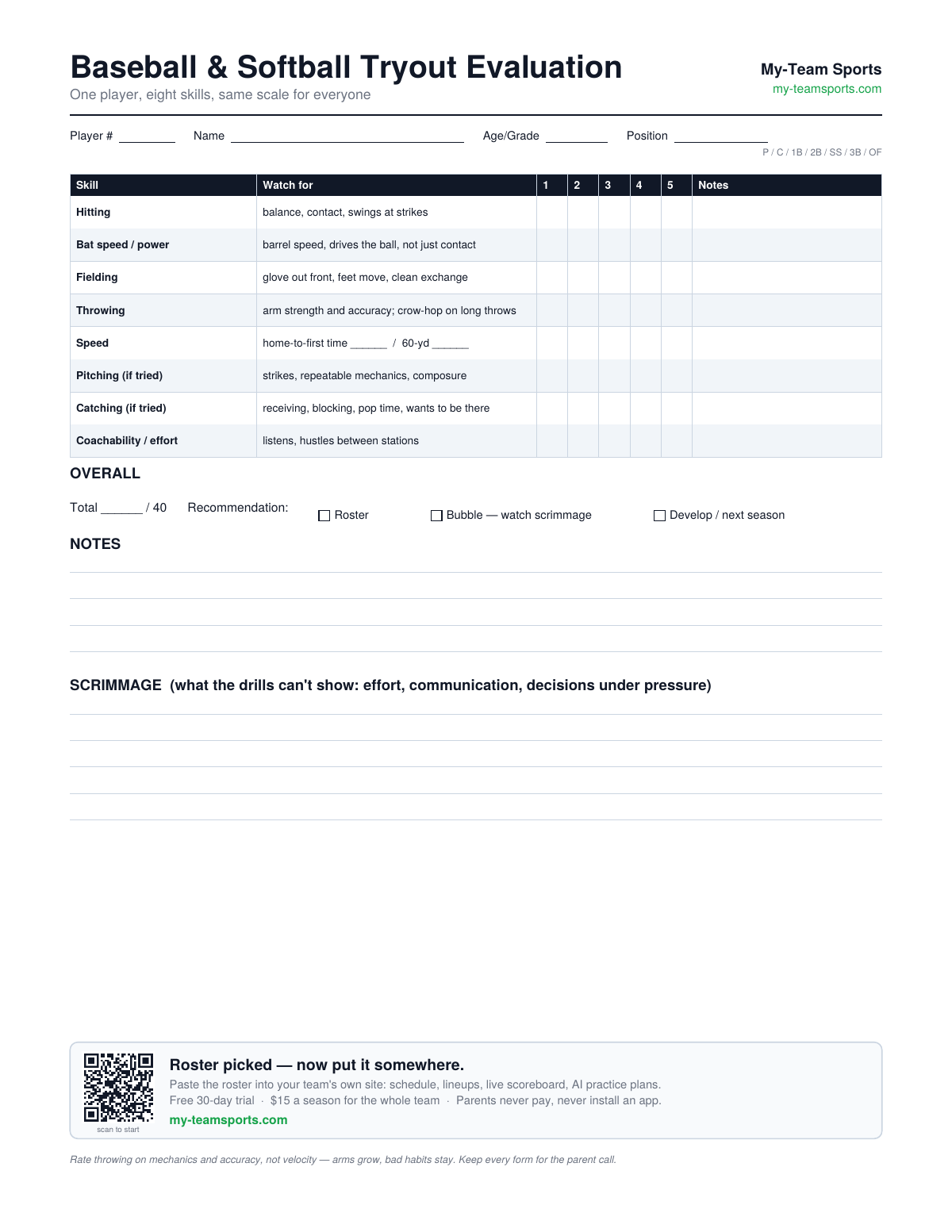
Baseball tryouts are the one day a year when a coach has to compare forty kids he has mostly never seen, in an hour, in cold weather, and then explain the result to their parents. The form is what makes that defensible. One player per page, eight skills rated 1 to 5 with a cue for what to watch, a line for the speed times, a total out of 40, a roster/bubble/develop recommendation, and a second page with a summary grid for the whole tryout. It works for baseball and softball — the skills are the same, only the arc of the pitch changes.
The eight things to rate
| Skill | Watch for | Not this |
|---|---|---|
| Hitting | Balance, contact, swings at strikes and takes balls | Home runs off a 40 mph machine |
| Bat speed / power | Barrel speed, drives the ball, hits it hard the other way | Size |
| Fielding | Glove out front, feet move to the ball, clean exchange | One diving play |
| Throwing | Accuracy first, then arm strength; crow-hop on long throws | Velocity on a cold arm |
| Speed | Home-to-first time, 60-yard time — write both on the form | Looking fast |
| Pitching (if tried) | Throws strikes, repeats the delivery, keeps composure after a walk | Radar gun readings at twelve |
| Catching (if tried) | Receives quietly, blocks, pop time, wants to be back there | Only the arm |
| Coachability / effort | Listens, hustles between stations, resets after an error | Volume |
Run the tryout so the numbers mean something
Number every player with tape and have evaluators write numbers, not names. Run the same stations in the same order for every group: a timed run (home to first, then 60 yards), infield ground balls with throws to first, outfield fly balls with throws to a cutoff, batting practice off a machine or a coach at a consistent speed, then pitchers and catchers who want to try it. Finish with a short scrimmage if there is time, because the scrimmage is where coachability and game sense show up. Two evaluators rate every player independently before comparing; the ones they disagree on are the ones to talk about.
- Rate throwing on mechanics and accuracy, not velocity. Arms grow; bad habits stay.
- Write the speed times on the form. A time is a number nobody argues with.
- Use the whole scale. A tryout where every kid is a 3 has sorted nothing.
- Rate pitching and catching only for kids who tried out for them; leave the box blank otherwise and total out of 30.
After the last whistle
Copy each player's numbers to the summary grid on page 2, sort by total, and make the easy calls first. The middle of the grid is where the notes column, the second evaluator's sheet and the scrimmage decide it. Write R, B or D in the decision column and keep every form — when a parent asks why, you will have eight numbers, two times and a sentence you wrote while watching.
Roster picked — now put it somewhere
The day after tryouts the season admin starts: the roster, the schedule, the field addresses, the rainout messages. With My-Team Sports you paste the roster in, the schedule goes on one page parents actually open, the game is scored live from a phone one at-bat at a time, and AB, hits, RBI and batting average add up over the season without a spreadsheet. No app for parents to install. The lineup card, depth chart and practice plan below are built for the first week.
Related coaching tools
Frequently asked questions
What should a baseball tryout evaluation form include?
Hitting, bat speed, fielding, throwing, speed, pitching and catching (for the kids who try them), and coachability, each on the same 1–5 scale with a cue for what to watch. Add the home-to-first and 60-yard times, a total, a recommendation and a notes line.
How do you run a fair youth baseball tryout?
Same stations in the same order for every group, players numbered, two evaluators rating independently, times written down, and the skill rated rather than one lucky result. Then sort the summary grid and spend the discussion on the middle.
Does this work for softball tryouts?
Yes. The eight skills are the same for softball; use the same form and the same scale. The only difference is what pitching looks like at the station.
What is a good home-to-first time for youth baseball?
It depends on age, and the point of writing the time on the form is to compare players in the same tryout, not to a chart. Within an age group, the fastest third and slowest third will be obvious once the times are on the grid.
How many players fit on the summary grid?
Twenty-six rows per page. For a larger tryout, print one grid per age group or per field.